
THE WARSAW PAPERS · NO. 2
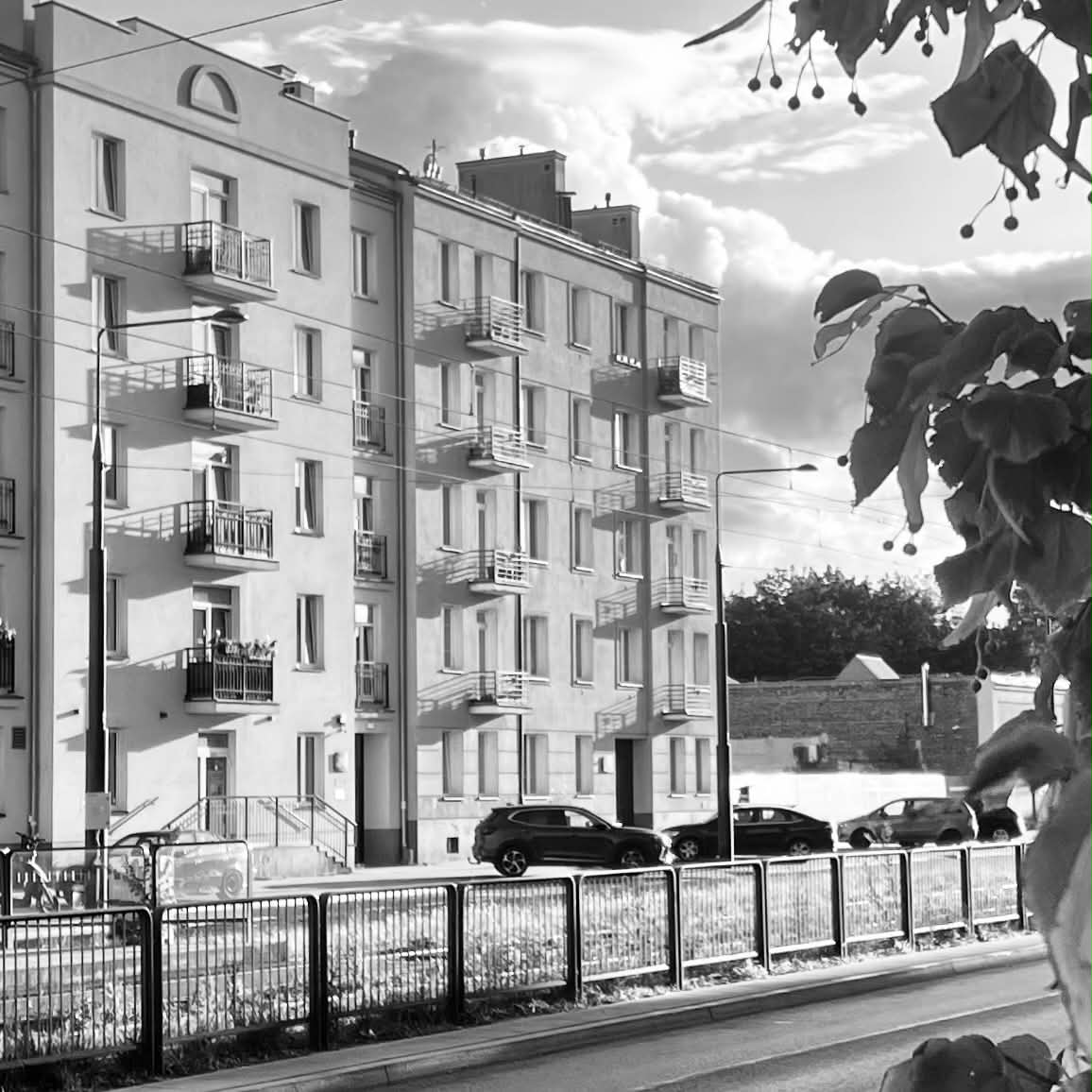
Kamionek, where a village, an empire, a factory district and a modern city learned to live in the same rooms
A pre-war apartment on Kamionek is not a sealed relic. It is a lived-in archive, standing among the memory of a medieval village, royal elections, imperial institutions, factories, parks and the practical domestic life of contemporary Warsaw.
A house that refuses to be one thing
There are Warsaw buildings that make an immediate argument. They announce themselves with columns, marble, symmetry or money. A pre-war tenement on Kamionek does something more interesting: it lets you enter before explaining itself.
The staircase may be modest. The courtyard may seem slightly too narrow. The front windows look onto Grochowska, a road that has spent centuries carrying people east and west, while the rear of the building holds the calmer geometry of sheds, balconies, washing lines and remembered repairs. Inside, a parquet floor may meet a contemporary kitchen; an old tiled stove may remain even when it no longer heats anything; double wooden windows still perform their seasonal ritual of draughts, dust and condensation. None of this is arranged as a lesson. It is simply how Warsaw survives: not as a reconstruction, but as a set of practical compromises that have acquired emotional weight.
The apartment visited by Warsaw Locals stands in a pre-war tenement on Kamionek, close to the former Perun factory. We do not publish the address. The point is not secrecy for its own sake, but proportion. This is a home, not an exhibit; a place where people live among the evidence of history without being obliged to turn every cupboard into a display case. To understand why such an apartment feels different, one must begin far earlier than the building itself. Kamionek is not merely an old Warsaw neighbourhood. It is a place where the chronology of Poland has repeatedly changed scale: from village to electoral field, from imperial margin to industrial district, from wartime landscape to contemporary residential quarter. The tenement is one small chamber inside that much larger historical body.
Before Warsaw reached it
Long before Kamionek became part of Warsaw, there was Kamion – a settlement on the right bank of the Vistula, associated in historical and topographical sources with one of the oldest inhabited zones in the area. Its name probably derives from stone or stony ground, though the landscape itself was shaped as much by water as by earth. The old river channels, damp meadows and low ground around today’s Lake Kamionkowskie remind us that the Vistula once behaved less like a regulated boundary and more like an impatient author, constantly revising the map.
The village lay near important routes and river crossings, but it remained outside the city for centuries. That distinction matters. Warsaw did not expand evenly, swallowing villages in a neat circle. It advanced through roads, railways, military regulations, industry and administrative decisions. Kamion was close enough to be affected by the capital, yet distant enough to preserve a separate identity.
The fields around Kamion also became associated with one of the most consequential experiments in European political history. In 1573, after the extinction of the Jagiellonian dynasty, the nobility of the Polish-Lithuanian Commonwealth gathered on the right bank of the Vistula to elect Henry of Valois. It was the first free royal election of the Commonwealth. The exact historical topography is debated, and modern memory has tended to attach the event to the broad open landscape of Kamionek. What is certain is more important than a pin on a map: this peripheral ground became, briefly, the stage on which a vast republic attempted to choose its monarch by political assembly.
Another disputed election took place in the area in 1733, when supporters of Augustus III assembled during a succession crisis. The name now given to Kamionkowskie Błonia Elekcyjne – the Kamionek Electoral Meadows – preserves that association. Today people walk dogs, cycle, picnic and push prams across this green space. The scale of the old political theatre has disappeared, but the openness remains. Warsaw has a talent for converting historical grandeur into everyday use. A field once linked with royal elections becomes the place where someone teaches a child to ride a bicycle.
A country absent from its own map
The late nineteenth century, when modern Kamionek began to take shape, is often described too casually as a period in Polish history. That phrase conceals the essential fact: there was no sovereign Polish state.
Warsaw was the largest city of the Kingdom of Poland, a territory subordinated to the Russian Empire. The failed uprisings of 1830-31 and 1863-64 had brought repression, intensified Russification and tighter imperial control. Public administration, education and architecture were all touched by the politics of domination. Yet the city continued to grow. Railways arrived, factories multiplied, populations moved, and new institutions emerged within a political order that many inhabitants regarded as foreign.
Kamionek was incorporated into Warsaw in 1889. The timing was not accidental. Nearby railway lines – the Terespol Railway, opened in the 1860s, and the Vistula River Railway of the 1870s – made the eastern districts attractive to industry. Grochowska developed from an old route into an urbanindustrial artery. Land was cheaper than in the centre, transport connections were useful, and factories could operate beyond the most prestigious parts of the city.
At the turn of the century the neighbourhood thus belonged to two realities at once. It was becoming modern, but not under a Polish state. It was urban, but still carried the memory of fields and village roads. Its development was driven by imperial institutions and capitalist enterprise, while its inhabitants lived within Polish, Jewish, Russian and other cultural worlds. This tension is one reason the architecture of Kamionek feels so layered. Buildings here were rarely allowed the luxury of belonging to a single historical narrative.
The veterinary institute: an imperial campus becomes a music centre
One of the clearest monuments to this period stands a short walk away: the former Veterinary Institute, today associated with Sinfonia Varsovia. Its buildings were erected in 1898-1900 to a design by Wladimir Pokrowski. The complex was laid out with a formal, almost palatial axial composition: a principal building, pavilions facing Grochowska and service structures deeper inside the site.
The choice of function was revealing. Veterinary science was not a decorative metropolitan pursuit. It was connected to an economy still heavily dependent on horses, livestock, transport, the army and food production. A modern veterinary institute on the edge of Warsaw belonged to the technological infrastructure of an empire.
Yet the site repeatedly changed its institutional identity. After 1918, when Poland regained independence, it served Polish university veterinary education. Later it became part of the Warsaw University of Life Sciences. Since 2010 it has housed Sinfonia Varsovia, and the historic campus is being transformed into a major centre of music.
Few Warsaw places express the city’s method of survival so elegantly. Buildings created under Russian rule for veterinary medicine now resonate with orchestral rehearsals. The architecture remains, but its purpose changes from imperial utility to civic culture. This is not erasure. It is reoccupation – one of Warsaw’s favourite forms of historical argument.
For a resident of a nearby tenement, the complex is not merely a landmark. It is part of the everyday route: a wall passed on the way to a shop, a gate glimpsed from a tram, a familiar silhouette. History here does not sit beyond a ticket barrier. It participates in errands.
Perun and the age of practical fire
Closer still is the former Perun factory, one of the landmarks of industrial Kamionek. The company began before the First World War and moved its operations from Wola to Grochowska in 1913. It produced industrial gases and modern welding equipment, expanding with workshops, production buildings and warehouses. Over the following decades Perun became closely linked to the development of welding technology in Poland.
There is something fitting about the name. In Slavic mythology, Perun is the god of thunder and lightning. The factory dealt in oxygen, flame, cutting and joining metal: myth converted into industrial procedure.
Industrial Warsaw is often remembered through chimneys and red brick, but its deeper importance was social. A factory reorganised time. It determined shifts, whistles, wages and the rhythm of streets. It attracted workers, generated workshops and shops, and transformed nearby housing into part of a larger economic organism. Tenements on Kamionek were not isolated domestic monuments. They belonged to a district where home and labour stood within walking distance of each other.
Perun’s buildings survived both world wars and continued to operate, under changing political and ownership structures, into the post-war era. In the twenty-first century the former industrial site became the subject of redevelopment plans, a familiar Warsaw story in which valuable land, historic fabric and new housing negotiate uneasily with one another.
From the windows and pavements of Kamionek, this transformation is visible in real time. The factory that once represented modernity becomes heritage; the tenement that once offered ordinary urban accommodation becomes desirable because it is old. Cities are capable of changing the status of buildings without moving a single brick.
The pre-war tenement as a machine for living together
The Warsaw tenement – kamienica – is frequently romanticised. Photographs favour decorative facades, iron balconies and patches of old plaster. Yet a tenement was primarily a financial and social machine: a building divided into apartments of different sizes and standards, arranged around courtyards that brought light, air, deliveries, noise and surveillance.
In wealthier central districts, front apartments could be spacious and ceremonial, while rear wings contained smaller, darker dwellings. On Kamionek the hierarchy was often more modest, but the basic logic remained. The street façade presented order. Behind it, daily life unfolded in layers.
A pre-war apartment carries traces of this logic even after repeated modernisation. Rooms may connect in an enfilade rather than along a corridor. Doors can be taller than contemporary ones. Windows are made to withstand Warsaw winters through depth and duplication. Ceilings hold a little more air above the head. Parquet floors are repaired rather than entirely replaced because they have already survived several systems of government and see no reason to surrender now.
The tiled stove is perhaps the most eloquent survivor. In many apartments it no longer provides heat. It remains as architecture, furniture and witness. A non-functioning stove is, in practical terms, absurdly large. Emotionally, it can anchor the room. It reminds residents that domestic comfort was once organised around fuel, ash, effort and local heat rather than an invisible municipal network.
Such interiors do not feel ‘historic’ in the museum sense because they have never stopped changing. Electrical cables, radiators, fitted kitchens, internet routers and contemporary lamps enter the old structure without asking permission from the original architect. The result is not purity. It is continuity – messier, funnier and far more truthful.
Park Skaryszewski: the city learns to breathe
Industrial growth did not eliminate the desire for landscape. At the beginning of the twentieth century Warsaw created one of its most ambitious public parks on the former Skaryszew pastureland. Park Skaryszewski was designed by Franciszek Szanior, the city’s chief gardener, and developed from 1905, with works continuing into the 1920s.
Szanior worked with a flat, wet site beside Lake Kamionkowskie. He reshaped it into a landscape park with artificial hills, ponds, waterways, curving paths, broad lawns and carefully composed views.
The design drew on the English landscape tradition but served an unmistakably modern urban purpose. It was made for movement, rest, sport and public encounter – not for aristocratic withdrawal. The park’s water is central to its character. Four ponds were connected with one another and with Lake Kamionkowskie, itself a remnant of an old Vistula channel. What appears natural is partly a work of engineering and composition. This is urban nature at its most convincing: designed so successfully that the design disappears.
During the interwar period the park gained further recreational and artistic features, including sporting grounds and sculpture. Its later history includes occupation, damage, post-war repair and changing patterns of use. Yet its social function remains remarkably stable. Warsaw residents come here to run, row, walk, flirt, feed birds, read, argue about dogs and claim temporary ownership of a bench.
For Kamionek, the park is more than a nearby attraction. It is the green counterweight to Grochowska, railway infrastructure and factory land. One can leave a brick courtyard and, within minutes, enter a landscape of water, old trees and long perspective. This proximity explains something essential about the neighbourhood: urban density and open land were never complete opposites here. They developed side by side.
The Electoral Meadows: history without a pedestal
East of the park lies Kamionkowskie Błonia Elekcyjne, a broad green area near the Exhibition Canal. The name is magnificent enough to suggest cavalry, banners and constitutional drama. The present reality is more democratic: grass, paths, bicycles, dogs and residents using the shortest route home.
The meadows are associated in local memory with the royal elections held on the fields of Kamion. Their precise historical boundaries cannot be established with certainty, and the modern green space should not be mistaken for a perfectly preserved sixteenth-century site. But cities do not remember only through exact archaeological coordinates. They also remember through names, habits and the decision to keep land open.
In the 1960s and 1970s the area was arranged for recreation, with paths and facilities introduced into the landscape. In 1993 it was entered in the register of monuments as valuable park greenery of spatial, landscape and ecological importance. The designation recognises something that urban development often forgets: emptiness can be heritage too.
This is especially important on Kamionek, where former industrial land attracts intense development pressure. A historic building is relatively easy to photograph and defend. An open meadow can appear to an investor as a failure to build. The Błonia insist on a different measure of value. They preserve distance, sky, movement and collective access.
They also connect the neighbourhood’s grand political memory with its present social life. The Commonwealth’s nobility once assembled in vast numbers to choose a king. Today the public arrives without heralds and chooses where to sit
War, destruction and the strange survival of ordinary buildings
No account of a pre-war Warsaw tenement can avoid the Second World War, but Kamionek complicates the familiar narrative. The right-bank districts experienced destruction, occupation, executions, military action and loss, yet much of their pre-war building fabric survived in greater quantity than in the annihilated central and western parts of Warsaw.
Survival, however, did not mean historical stasis. Apartments were subdivided, requisitioned, overcrowded and repaired with whatever materials were available. Ownership systems changed. New residents arrived, sometimes carrying memories of destroyed neighbourhoods or lost towns. Under state socialism, private domestic space acquired a peculiar importance: it was the place where family life, personal taste, unofficial conversation and small freedoms could be protected.
A pre-war tenement therefore contains more than pre-war history. Its walls also belong to the People’s Republic, to the shortages and improvisations of the post-war decades, to renovations undertaken without matching materials, to furniture inherited because replacement was difficult, and to the intense social theatre of shared staircases and courtyards.
Even now, old Warsaw buildings produce a specific acoustics of coexistence. One hears doors, pipes, footsteps, a neighbour moving a chair, someone practising music, a child in the courtyard. Modern developers sell silence as luxury. The tenement offers something else: evidence that otherlives exist close by.
What a visitor actually encounters
A visitor entering a real home on Kamionek does not encounter a complete historical narrative laid out in chronological order. That would be unbearable. Instead, history arrives in fragments. A wooden window explains winter better than a paragraph. A rounded corner near the ceiling reveals an old construction habit. Parquet bears the marks of furniture moved by people no longer known. The tiled stove is admired, then interrupted by a cat. Coffee is poured. Someone mentions that the former Perun factory is nearby. Another person explains that the vast green space beyond the park carries the memory of royal elections. The conversation shifts to contemporary Warsaw, to rents, trams, neighbours or where to buy good cake.
This is precisely why an authentic Warsaw home visit can reveal something that conventional sightseeing cannot. A city tour separates places into points of interest. A home reconnects them. The factory, park, electoral fields, veterinary institute and tenement are not isolated attractions. They belong to the same lived geography.
Warsaw Locals offers private home visits hosted by Warsaw residents. The homes are neither staged interiors nor museums. The aim is not to perform Polish life for visitors, but to allow a brief, respectful encounter with the way history and everyday life already coexist.
Kamionek rewards this kind of attention. Its past is not hidden, but it rarely introduces itself loudly. It waits in the alignment of a street, the depth of a window frame, the survival of a factory wall, the unexpected scale of a park and the extraordinary name of an ordinary meadow.
A neighbourhood made from interruptions
The temptation when writing about Warsaw is to search for a single moment of truth: the village, the election, the imperial city, the interwar republic, the factory age, the war, communism or the present. Kamionek refuses the simplification.
Its identity was formed by interruptions. The village became urban without entirely disappearing. The imperial institute became a Polish university and later a home for music. Industrial modernity became industrial heritage. A royal electoral landscape became recreational greenery. A pre-war tenement absorbed war, socialism, market reform, renovation and contemporary domestic life.
This is why entering such a building can feel more revealing than looking at a perfectly restored monument. Perfection removes time. A lived-in apartment allows different periods to remain in negotiation.
The finest detail may be the least dramatic: the fact that the home is still a home. Someone waters plants near an old window. Someone complains about the stairs. Guests sit around a table where no historical event has occurred, and yet the whole history of the neighbourhood seems to have made the meeting possible. Warsaw is often introduced through what it lost. Kamionek offers another story: what remained, what changed function, what was adapted, and what continues to be used without ceremony. Inside a pre-war tenement, the past does not live behind glass. It asks whether you take milk in your coffee.
Selected Sources
Sinfonia Varsovia Centrum, ‘Miejsce’: history and architecture of the former Veterinary Institute
complex, built in 1898-1900 to a design by Wladimir Pokrowski.
PERUN S.A., company history and materials concerning the former industrial complex.
Bogumił Mińkowski and Piotr Nitecki, Kamionek, Warsaw: Wydawnictwo Archidiecezji Warszawskiej, 1988.
Andrzej Sołtan, ed., Warszawska Praga dawniej i dziś, Warsaw: Muzeum Historyczne m.st. Warszawy, 1998.
Marcin Wicha and Agnieszka Rayss, Kamionek, Warsaw: Muzeum Warszawy, 2025.
Jarosław Zieliński, Atlas dawnej architektury ulic i placów Warszawy, vol. 4, Warsaw: Towarzystwo Opieki nad Zabytkami, 1997.
City of Warsaw, historical and environmental materials on Kamionek, Park Skaryszewski and Kamionkowskie Błonia Elekcyjne.
See the Homes behind the stories.
History becomes much more meaningful when experienced in the place where it happened. Visit a real Warsaw home, meet its residents, share coffee and discover the city through everyday life rather than museum labels.